Your "safe foods" list keeps shrinking. The low-histamine diet helped at first, but now you're reacting to almost everything. We identify which gut bacteria are producing histamine and which degrading bacteria are missing - so you can address the root cause and actually expand your diet again.
We hear this constantly. You discovered histamine intolerance after years of unexplained symptoms—the headaches, flushing, digestive issues, anxiety, skin reactions. Finally, a name for what you've been experiencing.
You started a low-histamine diet and felt better. For a while.
But then you noticed reactions to foods that should be "safe." Your list of tolerable foods kept shrinking. You became anxious about eating out, travelling, or attending social events.
Why does restriction stop working?
Because diet restriction only manages the histamine entering your body from food. It doesn't address the histamine being produced inside your gut by bacteria.
Your gut microbiome can be an internal source of histamine. Certain bacteria convert the amino acid histidine into histamine as a metabolite. Other bacteria help break histamine down. When these populations become imbalanced—too many producers, too few degraders—your histamine load overflows no matter how carefully you eat.
At Prana Thrive, we identify which bacteria are driving your histamine burden so you can stop restricting and start healing.
See how we fix
Histamine intolerance (5 min)
WATCH NOW
Book your free Histamine evaluation call
BOOK FREE CALL
Most advice focuses on avoiding high-histamine foods. But research shows your gut microbiome is a massive internal source of histamine - often more significant than what you eat.
How histamine overload works:
Histamine overload happens when multiple factors combine:
Mast cell release - Your immune cells release histamine in response to allergens or triggers
Dietary histamine - Foods like aged cheese, wine, fermented products add to the load
Bacterial histamine production - Certain gut bacteria produce histamine as a metabolite
Insufficient breakdown - Your enzymes (DAO, HNMT) and degrading bacteria can't clear it fast enough
When these factors overwhelm your body's ability to break histamine down, you get symptoms: headaches, flushing, anxiety, bloating, skin reactions, fatigue.
The two bacterial factors we test for:
1. Histamine-Producing Bacteria (Too Many)
Over 100 bacterial species can convert the amino acid histidine into histamine. When these bacteria overgrow - whether from dysbiosis or SIBO - they flood your system with histamine from the inside.
Common producers: Klebsiella, Morganella morganii, Proteus, certain E. coli strains, Enterobacter, Streptococcus
2. Histamine-Degrading Bacteria (Too Few)
Certain beneficial bacteria help break down histamine before it causes problems. When these are depleted, you lose a critical line of defence.
Key degraders:
Bifidobacterium species (B. infantis, B. longum)
Lactobacillus species (L. plantarum, L. rhamnosus, L. reuteri)
The Result: If you have elevated producers and depleted degraders, you'll react to foods even on a strict low-histamine diet - because the histamine is coming from inside your gut, not just your plate.
🔬THE MICROBIOLOGIST'S PERSPECTIVE
"When I review microbiome results for histamine clients, I'm looking at the balance between producers and degraders. The pattern I see repeatedly is elevated Klebsiella or Enterobacter alongside depleted Bifidobacterium and Lactobacillus species - particularly B. longum, L. plantarum, and L.rhamnosus. These degrading species don't just break down histamine directly; some also influence how much histamine your body releases in the first place. Once we identify the specific imbalance, we can target it - reducing producers while rebuilding the degraders that should be protecting you."

Victoria Samios, Microbiologist
Standard treatment usually stops at "avoid these foods" and "take this enzyme." Here's why that approach keeps you stuck:
1. The Low-Histamine Diet Trap
Dietary restriction reduces the histamine entering your body from food - but it does nothing about the histamine being produced inside your gut by bacteria. Over time, as your microbiome remains imbalanced, you have to restrict more and more foods to get the same relief. The diet that once helped becomes a shrinking prison.
2. The Enzyme Piece (It's More Complex Than You've Been Told)
You may have heard of DAO (diamine oxidase), the enzyme that breaks down histamine in your gut. DAO dysfunction is often blamed on genetics - but the reality is more nuanced:
Gut lining damage - DAO is produced by intestinal cells (enterocytes). If you have IBD, SIBO, or intestinal inflammation, your gut lining may be too damaged to produce adequate DAO
Certain bacteria influence DAO - Some bacterial species have been correlated with either elevating or suppressing DAO release
Leaky gut complicates the picture - When intestinal permeability is compromised, DAO can leak into the bloodstream, increasing serum levels but reducing its availability where it's needed (in the gut)
Nutrient deficiencies - DAO requires vitamin B6 and other cofactors to function
The Bottom Line: DAO is one piece of a complex puzzle. Focusing only on DAO supplements misses the bacterial imbalance driving histamine production in the first place - and ignores the degrading bacteria that should be helping clear histamine naturally.
Many clients with histamine intolerance also have undiagnosed SIBO (Small Intestinal Bacterial Overgrowth). This isn't a coincidence.
SIBO creates an environment where histamine-producing bacteria thrive in the small intestine - right where food absorption happens. This dramatically spikes your histamine load before food even reaches your colon.
SIBO also damages the intestinal lining, which can impair DAO production and increase intestinal permeability - making the histamine problem worse on multiple fronts.
If you have bloating + histamine reactions: SIBO is likely contributing
Our approach: We test for both simultaneously. Treating the SIBO is often the turning point for histamine clients
If you've been researching histamine, you've likely come across MCAS - Mast Cell Activation Syndrome. These conditions are related but distinct.
Histamine intolerance is primarily a breakdown problem: your body can't clear histamine fast enough, whether due to bacterial imbalance, enzyme dysfunction, or gut damage.
MCAS is a mast cell problem: your mast cells are overactive and release too much histamine (plus other inflammatory mediators) in response to triggers.
Many people have overlapping features of both. The gut microbiome plays a role in both conditions - certain bacteria can influence mast cell behaviour, and gut inflammation can trigger mast cell activation.
Our approach: We focus on the gut microbiome factors we can identify and address through testing. For many clients, resolving the bacterial imbalance and healing the gut significantly reduces symptoms - regardless of whether the primary driver is histamine intolerance, MCAS features, or both.
🌿 THE NATUROPATH'S PERSPECTIVE
"After analysing over 2,000 microbiome tests, I've seen a clear pattern with histamine clients: they arrive after months or years of restrictive diets, frustrated because they aren't getting better - just more restricted. When we test, we almost always find the same thing: elevated histamine-producing bacteria and depleted species that should be degrading histamine naturally. My goal isn't managing your symptoms forever. It's rebalancing the bacteria, supporting gut healing, and getting you back to eating tomatoes, avocado, and leftovers without fear."

Amanda Ledwith, Naturopath
See how we fix
Histamine intolerance (5 min)
WATCH NOW
Book your free Histamine evaluation call
BOOK FREE CALL
Unlike conventional approaches that just suppress histamine, our AIM Method™ addresses why your body can't clear it properly—and guides you to lasting tolerance, not endless restriction.
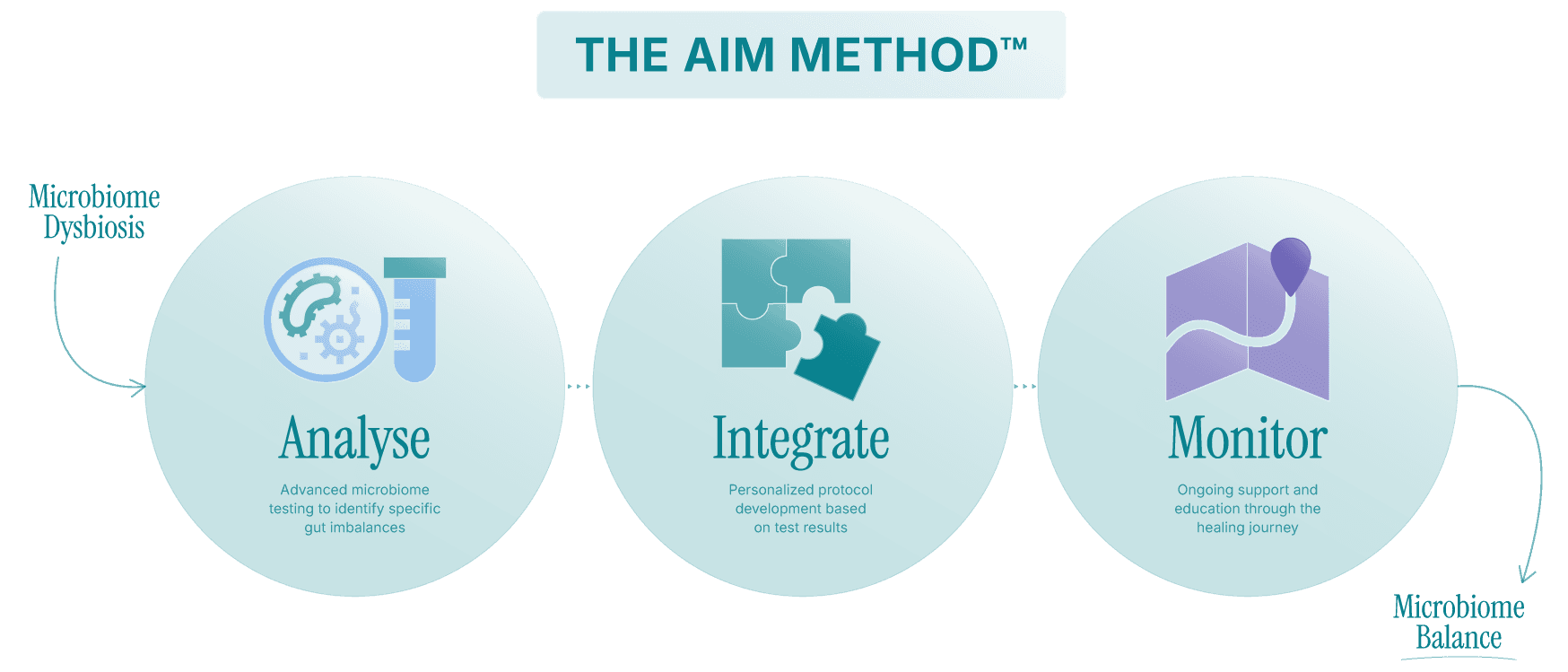
Analyse: Identify the Bacterial Imbalance
We use metagenomic sequencing to identify:
Which histamine-producing bacteria are elevated (Klebsiella, Morganella, Enterobacter, etc.)
Which histamine-degrading bacteria are depleted (B. longum, B. infantis, L. plantarum, L. rhamnosus, L. reuteri)
Whether SIBO is present (common co-factor)
Markers of gut barrier integrity and inflammation
Victoria reviews every result to identify the specific patterns driving your histamine load.
Integrate: Reduce, Restore, Repair
We build a protocol specific to your test findings:
Reduce: Targeted antimicrobials to lower histamine-producing bacteria
Restore: Specific probiotic strains known to degrade histamine (Bifidobacterium and Lactobacillus species)
Repair: Support for gut lining healing (which affects enzyme function and permeability)
Monitor: Expand Your Diet Safely
We don't hand you a protocol and disappear. For 3-6 months, we guide you through treatment and the reintroduction phase - systematically testing foods to expand your diet rather than restrict it further.
✅ You're an ideal candidate if:
Your low-histamine diet helped initially but has stopped working
Your list of "safe" foods keeps shrinking
You react to foods that should be low-histamine
You have symptoms like headaches, flushing, racing heart, or anxiety after meals
Your symptoms worsen with alcohol (especially red wine)
You suspect SIBO or have been diagnosed with IBS
You've been told you might have MCAS and want to address the gut component
🤔 You may not need specialist support if:
You haven't tried a low-histamine diet yet (we recommend starting there first)
Your symptoms are mild and easily managed
You aren't ready to follow a structured protocol
Not sure if testing is right for you?
Book a free 15-minute evaluation call - we'll give you honest guidance.
EMMA'S STORY
"I was down to 15 foods"
Emma, 38, had been managing histamine intolerance for two years. What started as a helpful diet had become a prison—she was down to about 15 "safe" foods. She avoided social events and felt anxiety before every meal.
The Breakthrough:
Microbiome testing revealed elevated Klebsiella pneumoniae and Proteus mirabilis—both histamine-producing species. Her Bifidobacterium and Lactobacillus populations were severely depleted, meaning she had few bacteria helping to degrade histamine. She also had SIBO, which was amplifying the problem.
The Outcome:
We used targeted antimicrobials for six weeks to reduce the histamine-producing bacteria, while introducing specific probiotic strains to rebuild her degrading capacity. We also focused on gut lining support.
By week eight, her symptoms had reduced by 80%. By four months, she had reintroduced tomatoes, avocado, and moderate amounts of aged cheese. She now eats out at restaurants again without fear.
Read more client success stories
You've restricted enough foods. You've missed enough social events. You've spent enough time anxious about what you can safely eat.
Histamine intolerance doesn't have to mean lifelong limitation. When you identify and address the bacterial imbalance driving your symptoms—reducing the producers, rebuilding the degraders—you can expand your diet instead of restricting it further.
No pressure. No obligation.
Just clarity on what's actually driving your symptoms and whether our approach can help.
We're based in Perth, Western Australia, and work with clients
across the entire country via secure video consultation.

Perth & WA,
Sydney & NSW,
Melbourne & VIC,
Brisbane & QLD,
Adelaide & SA,
Hobart & TAS,
Canberra & ACT,
Darwin & NT
and regional and remote areas throughout Australia.
Your test kit ships Australia-wide with prepaid return postage included.
Whether you're in Perth or Cairns, you receive the same comprehensive analysis from our microbiologist Victoria and naturopath Amanda.
Is histamine intolerance genetic?
Genetic variations in the DAO enzyme (AOC1 gene) do exist and can contribute to histamine intolerance. However, for most clients we see, the primary issue is functional—not purely genetic. Gut inflammation, SIBO, bacterial imbalance, and intestinal damage all impair your body's ability to handle histamine, regardless of your genetics. We focus on the factors we can actually change.
What about DAO supplements—should I take them?
DAO supplements can provide temporary relief by helping break down histamine from a meal. But they don't address why your histamine load is high in the first place. They don't reduce bacterial histamine production, and they don't rebuild the degrading bacteria you're missing. We may use DAO strategically during treatment, but the goal is restoring your body's natural capacity—not supplement dependence.
Do I need to stay on a low-histamine diet forever?
No—that's the whole point of addressing the root cause. We use dietary restriction as a temporary tool (typically 4-8 weeks) to reduce the incoming histamine load while we treat the bacterial imbalance. Our goal is diet expansion, not lifelong restriction.
What if I also have SIBO?
This is extremely common. SIBO creates an environment where histamine-producing bacteria thrive in the small intestine, dramatically increasing your histamine load. Treating SIBO is often the turning point for histamine clients. We test for and treat both simultaneously.
What's the difference between histamine intolerance and MCAS?
Histamine intolerance is primarily a breakdown problem—your body can't clear histamine efficiently. MCAS (Mast Cell Activation Syndrome) is a mast cell problem—your mast cells release too much histamine and other mediators. Many people have overlapping features. We focus on the gut microbiome factors that influence both conditions. Resolving bacterial imbalance and healing the gut often significantly improves symptoms regardless of which label applies.
How long until I see improvement?
Most clients notice meaningful improvement within 6-8 weeks of starting treatment. Full resolution—including successful food reintroduction—typically takes 3-6 months depending on the severity of bacterial imbalance and whether SIBO is present.