What Is Akkermansia Muciniphila?
Plus Some Surprising Benefits!


Author:
Amanda Ledwith, BHSc Naturopathy
Last Updated:
Reading Time:
21 mins
Categories:
Probiotics & Bacteria
akkermansia-muciniphila
What You'll Learn
Akkermansia muciniphila is a beneficial gut bacteria that makes up 1–5% of a healthy microbiome. It's called the "caretaker" of your mucus layer—the protective blanket that shields your gut lining.
What Akkermansia does:
Eats mucus (stimulating fresh mucus production)
Maintains gut lining integrity
Modulates immune responses
Inhibits inflammation
Cross-feeds other beneficial bacteria (Faecalibacterium prausnitzii, Roseburia, Eubacterium)
Low Akkermansia is linked to:
Inflammation
Type 2 diabetes
Inflammatory bowel disease (IBD)
Obesity and weight loss resistance
Leaky gut symptoms
How to support Akkermansia:
Omega-3 foods (chia, flax, hemp seeds, fish oil)
Pomegranate
Polyphenol-rich foods (blueberries, cacao, cranberries)
Resistant starch and prebiotic fibre
Akkermansia probiotic supplement (only if levels are absent or extremely low)
Why testing matters: Gut microbiome testing reveals your exact Akkermansia levels. Too low = leaky gut risk. Too high = excess mucin degradation (constipation). Balance is key—and testing shows whether you need to increase, maintain, or be cautious with Akkermansia-supporting interventions.
Ever wondered if a microbiome test is worth the hype? Knowing your Akkermansia levels could be the key to overcoming your health concerns …
In many cases it definitely can, read on to learn exactly why …
As a gut health focused naturopath, one of my favourite functional tests is gut microbiome testing.
Microbiome testing provides a detailed snapshot of my clients’ unique gut microbiome bacteria. It allows me to ‘see’ exactly which microbes are in abundance, those that are lacking and whether gut dysbiosis (or imbalance) may be occurring.
I use this invaluable information with amazing results…every single day.
As well as looking closely at a client’s personal health challenges, symptoms and current dietary needs, I use their microbiome test results to make even more targeted recommendations.
The need for probiotics, functional supplements, dietary changes and even lifestyle tweaks can be revealed in microbiome testing – all with the goal of bringing balance back to their gut (and health).
Sound too simple?
It really can be that straightforward…
…But only when you know what you’re looking at.
Gut testing provides comprehensive information about scores of different types of bacteria, ratios of important groups, bacterial metabolites and so much more.
Believe it or not, there really is an ecosystem living in your gut.
Your Microbiome By Numbers
The latest estimates suggest that a staggering 100 trillion cells live in your gut microbiome. If the conditions within us are just right, these organisms live in perfect harmony with us.
It’s thought our gut microbiome supports over 1000 species of microorganisms. The overall health of our gut changes because of alterations of the human gut microbiome, most significantly influenced by diet.
Another simple, yet true gut health fact.
We choose which bacteria will flourish with our food choices.
Diet determines whether we nurture beneficial bacteria in our gut (or not) – this uncomplicated process holds the key (and the power) to increase or decrease the risk for some infections and many diseases.
This is where gut microbiome testing comes in.
Trained practitioners are able to interpret this information and provide vital feedback about your health concerns – here we are going to focus on just one pivotal bacterial species, Akkermansia muciniphila.
But not everyone has it.

Akkermansia – the hidden gem
Low levels of Akkermansia muciniphila (from now on we will call it A.muciniphila for short) have been linked with numerous conditions. Like:
Inflammation
Type 2 diabetes
ASD
Obesity and weight loss

But we’ll talk mostly about one that most of us will struggle with in our lifetimes – weight loss.
Despite the weight loss industry boom we are still getting heavier as a global population. Our generational break away from traditional eating is starting to reveal the error in our ways.
We are eating ourselves unwell.
In an attempt to further understand the mechanisms behind our struggle to lose weight as a species, research is also booming.
Recent studies have revealed a close connection between the identity of one’s gut microbiome and the development of obesity, especially A.muciniphila.
So, what is A.muciniphila?
Discovered in 2004 and named after the Dutch microbiologist Dr Antoon Akkermans, A.muciniphila is a Gram-negative, oval shaped, anaerobic bacteria found universally in the animal kingdom.
It’s also known as a true symbiont of humans.
What does this all mean for us…?
In a nutshell, A.muciniphila thrives in the anoxic (oxygen poor) environment of our gut and lives in true symbiosis with us – offering no harm and countless benefits.
How?
By eating mucus.
Sounds odd but it’s absolutely true.
Allow me to explain.
Mucus – the good type
To maintain the health and integrity of our gastrointestinal tract we have an insulating mucus layer that coats our gut lining.
This crucial layer forms a protective blanket that shields and protects our phenomenally complex single-cell layer – our gut lining.
The mucus layer performs a dizzying array of functions including:
Protecting our gut lining from our food particles and antigens
Keeping gut microbes from infiltrating our intestinal walls
Preventing harmful byproducts from stimulating immune responses (that can trigger inflammation)
And many many more…
Our multi-layered gut mucus also provides an adhesive surface for numerous microbes.
Meaning that it actually attracts bacteria to colonize, survive and multiply within and on the mucus layer, serving as a nutrient source for bacterial growth.
Over the last few years, it has become clear that some microbes benefit us more than others.
A.muciniphila is one of those – a beneficial bacterium believed to have anti-inflammatory effects in humans leading to greater weight loss results.
This species of gut bacteria is acknowledged to be the “caretaker” of our mucus layer.
Akkermansia’s Secret Role
A now widely acknowledged probiotic, Akkermansia is abundant in the healthy human intestinal tract – making up to 1-5% of the entire microbial community of the colon.
Mucus production (and thickness) is a key indicator of gut health and Akkermansia is fundamental in this process. Some of its primary functions include:
Gut lining integrity promotion
Immune response modulation
Inflammation inhibition
Syntropy or cross-feeding
Akkermansia is generally located closer to our intestinal cell wall than the majority of other bacteria. It colonizes the human intestine at a very young age and while using mucus as food, it actually promotes the mucus cells in our gut lining to produce more mucus.

Like supply and demand it keeps the mucus turnover fresh and strong.
One of the features that makes it stand out in the gut is its ability feed solely on mucin.
Other gut bacteria, like Bacteroides fragilis, Ruminococcus gnavus and Bifidobacterium bifidum (to name a few), can also use mucin as a food source, but these bacteria can also switch to other food sources.
A.muciniphila only has genes for enzymes that degrade mucus – it’s their singular carbon and nitrogen food source.
Additionally, they:
Release signaling molecules that stimulate and reinforce the intestinal cell wall
Produce beneficial oligosaccharide and short-chain fatty acid metabolites
Inadvertently reduce abundance of non-beneficial bacteria like Shigella
Cross-feed beneficial bacteria like Faecalibacterium prausnitzii, Eubacterium rectale, Roseburia intestinalis, Anaerostipes caccae
In brief, Akkermansia degrades the mucus layer, stimulating new mucus production. The production of new mucus stimulates growth of Akkermansia. This process ensures that there are plentiful amounts of Akkermansia available to maintain integrity and shape of the mucus layer.
So what does all this mean for weight loss?
🔬 VICTORIA’S EXPERT INSIGHT
“When I review microbiome test results, Akkermansia muciniphila is one of the first species I look at—it tells me so much about gut barrier integrity and metabolic health.
What I assess with Akkermansia:
1. Presence vs. Absence Some clients have completely absent Akkermansia—it’s simply not detected on their test. This is a significant finding because Akkermansia is foundational for mucus layer health. When it’s absent, I know gut barrier integrity is likely compromised, and we need to consider whether targeted supplementation (the Akkermansia probiotic) is appropriate alongside dietary interventions.
2. Low Levels (below 1%) When Akkermansia is present but low (below 1% of the microbiome), I see consistent patterns: often leaky gut symptoms, inflammation, weight loss resistance, and blood sugar dysregulation. These clients typically benefit from omega-3 rich foods, pomegranate, polyphenols, and resistant starch to support Akkermansia growth.
3. Optimal Levels (1–5%) This is the healthy range. When I see Akkermansia at 1–5%, I know the mucus layer is being maintained, gut barrier integrity is supported, and the cross-feeding relationship with other beneficial bacteria (Faecalibacterium prausnitzii, Roseburia) is functioning well.
4. Elevated Levels (above 5%) Here’s what most practitioners miss: too much Akkermansia can be problematic. When levels are very high, I see excess mucin degradation—the mucus layer is being broken down faster than it’s being rebuilt. This often presents as constipation and can actually compromise gut barrier integrity. Balance is key.
The cross-feeding insight: Akkermansia doesn’t work alone. When it breaks down mucus, it produces metabolites that feed other crucial beneficial bacteria—particularly Faecalibacterium prausnitzii (our primary butyrate producer). So when I see low Akkermansia, I often see low F. prausnitzii as well. They’re part of the same ecosystem, and addressing one often helps the other.”
— Victoria, Microbiologist
Book Your Free Evaluation Call

Akkermansia And Weight Loss
One of the many exciting effects that Akkermansia muciniphila has on gut health is welcome news to those struggling with long-term weight loss issues.
Initially proven on mice, researchers have found that an increase in Akkermansia corresponds to a reduction in:
Insulin resistance
Dyslipidemia – unhealthy blood lipid (fat) levels
Metabolic endotoxemia – toxins in the blood typically from pathogenic microbes
Fat mass gain
There is also evidence for correlations between A.muciniphila and:
A link between dietary fats
Gut flora composition
Inflammation levels
So researchers saw that Akkermansia seems to support health in mice…
…But what about the human gut?
Recently it was demonstrated that overweight and obese adults who had higher levels of the Akkermansia muciniphila had better clinical measures after diet interventions – including reduced visceral fat!!!
A wonderful and very promising result.
However, research is ongoing – especially in human trials. So that more knowledge can be gathered to further associate Akkermansia muciniphila and weight loss. If you’re interested in the gut-weight connection there is plenty of wonderful evidence around gut bacteria and weight loss, which you can read here.

How to Support Your Akkermansia
We regularly see clients with very low or even no Akkermansia levels in the gut. Many have typical leaky gut symptoms which we work together to correct where possible.
Only recently, an Akkermansia muciniphila probiotic supplement was released! After being in development for so long, we were so excited to get started recommending it to clients that needed it.
And we even have in house retest data that shows it is colonising, and changing microbiomes!
If you’d like to read about the brand we use you can find more information here. But we only recommend it to those with absent or extremely low Akkermansia levels.
If you have sufficient levels you can support your A.muciniphila colony through the consumption of certain prebiotics and foods. There are a couple of standouts though, the humble (but expensive) pomegranate and also omega 3 foods.
I recommend all my clients with below optimal levels of Akkermansia to increase their consumption of omega 3 foods for this very reason.
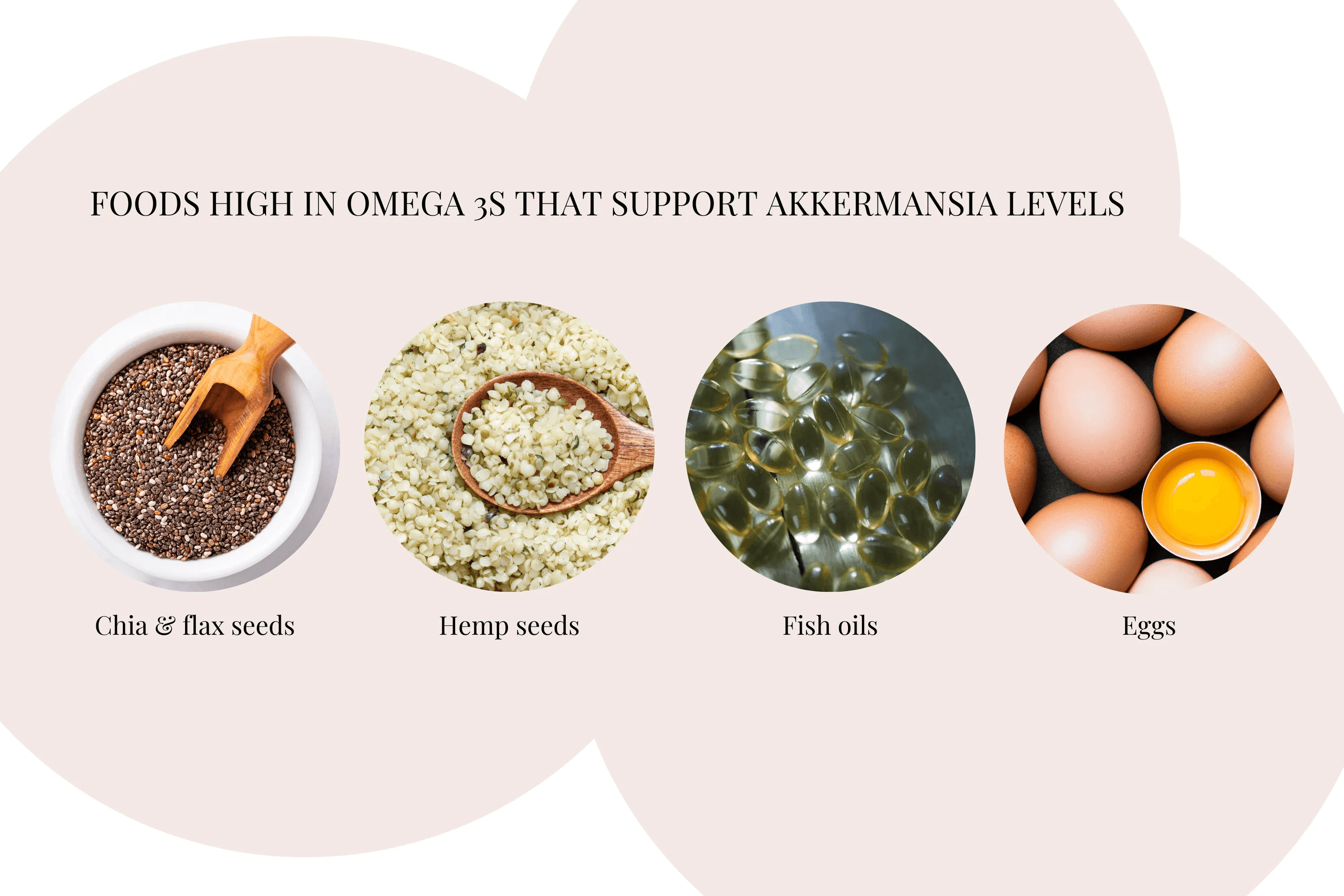
Foods high in omega 3s that support Akkermansia levels include:
Chia and flax seeds
Hemp seeds
Fish/algae oil
Eggs (unless your sulphur-reducing bacteria are too high)
It is also important to regularly consume foods rich in resistant starch and prebiotic fibre. Other supportive practices include:
Adding a high quality multistrain probiotic supplement
Lower your intake of sugar, carbs, processed food and
Increase the consumption of healthy fats and fresh vegetables
Consume fermented foods
Eat mango
Eat cranberries
Polyphenol rich foods – cloves, thyme, rosemary, cacao, flaxseed meal, celery seed, blueberries
But it’s also important not to overdo it, especially so if you already have optimal Akkermansia levels. As always balance is key – too much Akkermansia is often accompanied by too much mucin degradation – leaving the gut lining exposed and often linked to constipation. Exactly what we don’t want and a great example of why gut testing is so important.
If you are looking for more ideas about how to naturally improve your gut health, we have an epic article titled “How to Improve Gut Health Naturally: The Ultimate Guide” you can access it here.
Book Your Free Evaluation Call
Q: What is Akkermansia muciniphila and why is it important?
A: Akkermansia muciniphila is a beneficial gut bacteria that makes up 1–5% of a healthy microbiome. It's called the "caretaker" of your mucus layer—the protective blanket that shields your gut lining from food particles, pathogens, and inflammatory triggers. Akkermansia eats mucus (which stimulates fresh mucus production), maintains gut barrier integrity, modulates immune responses, inhibits inflammation, and cross-feeds other beneficial bacteria like Faecalibacterium prausnitzii. Low levels are linked to inflammation, weight loss resistance, type 2 diabetes, and IBD.
Q: How do I know if my Akkermansia levels are low?
A: You can’t know your Akkermansia levels from symptoms alone—gut microbiome testing reveals your exact percentage. However, common signs of low Akkermansia include: leaky gut symptoms (food sensitivities, bloating, fatigue), weight loss resistance despite diet efforts, blood sugar dysregulation, chronic inflammation, and digestive issues that don’t resolve with standard approaches. Testing shows whether Akkermansia is absent, low, optimal, or elevated—each requiring different interventions.
Q: Can I take an Akkermansia probiotic supplement?
A: Yes—Akkermansia muciniphila probiotic supplements are now available (we use Pendulum). However, we only recommend supplementation for clients with absent or extremely low Akkermansia levels confirmed by testing. If your levels are already sufficient, supplementation isn't necessary—and if levels are elevated, it could worsen symptoms. Our retest data shows the supplement does colonise and shift microbiomes, but it needs to be used appropriately based on your specific test results.
Q: What foods increase Akkermansia levels?
A: The best foods for supporting Akkermansia include: omega-3 rich foods (chia seeds, flax seeds, hemp seeds, fish oil, eggs), pomegranate (research shows pomegranate ellagitannins specifically stimulate Akkermansia growth), polyphenol-rich foods (blueberries, cranberries, cacao, cloves, thyme, rosemary), resistant starch (cooked and cooled potatoes, green bananas), prebiotic fibre, navy beans, and mango. However, if your Akkermansia is already elevated, increasing these foods could worsen symptoms—testing reveals what your gut actually needs.
Q: Can you have too much Akkermansia?
A: Yes—this is what most practitioners miss. When Akkermansia levels are too high (above 5%), excess mucin degradation occurs—the mucus layer is broken down faster than it's rebuilt. This often presents as constipation and can actually compromise gut barrier integrity. When Victoria sees elevated Akkermansia on test results, she recommends caution with Akkermansia-supporting foods and supplements. Balance is key, and testing shows whether you need to increase, maintain, or be cautious.
Q: How does Akkermansia relate to weight loss?
A: Research shows that higher Akkermansia levels correlate with reduced insulin resistance, healthier blood lipid levels, lower metabolic endotoxemia (toxins from pathogenic bacteria), and reduced fat mass gain. Studies in overweight adults found that those with higher Akkermansia had better clinical measures after diet interventions—including reduced visceral fat. The mechanism: Akkermansia maintains gut barrier integrity, reducing systemic inflammation that drives metabolic dysfunction and weight loss resistance. If you've struggled with weight loss despite diet efforts, testing your Akkermansia levels may reveal a missing piece.
Q: How does Akkermansia connect to other beneficial bacteria?
A: Akkermansia doesn't work alone—it's part of a cross-feeding ecosystem. When Akkermansia breaks down mucus, it produces metabolites (oligosaccharides and short-chain fatty acids) that feed other beneficial bacteria, particularly Faecalibacterium prausnitzii (our primary butyrate producer), Roseburia intestinalis, and Eubacterium rectale. When Victoria sees low Akkermansia on test results, she often sees low F. prausnitzii as well. Addressing Akkermansia often helps rebuild these connected species—they're part of the same beneficial ecosystem.
Q: I have IBD—is Akkermansia relevant to my condition?
A: Yes. Low Akkermansia levels have been linked to inflammatory bowel disease (IBD)—both Crohn's disease and ulcerative colitis. The mechanism: Akkermansia maintains mucus layer integrity and has anti-inflammatory effects. When Akkermansia is depleted, the mucus layer thins, gut barrier integrity is compromised, and inflammation increases. Testing reveals your Akkermansia levels alongside other bacterial imbalances contributing to IBD symptoms, allowing targeted protocols to rebuild this protective species.